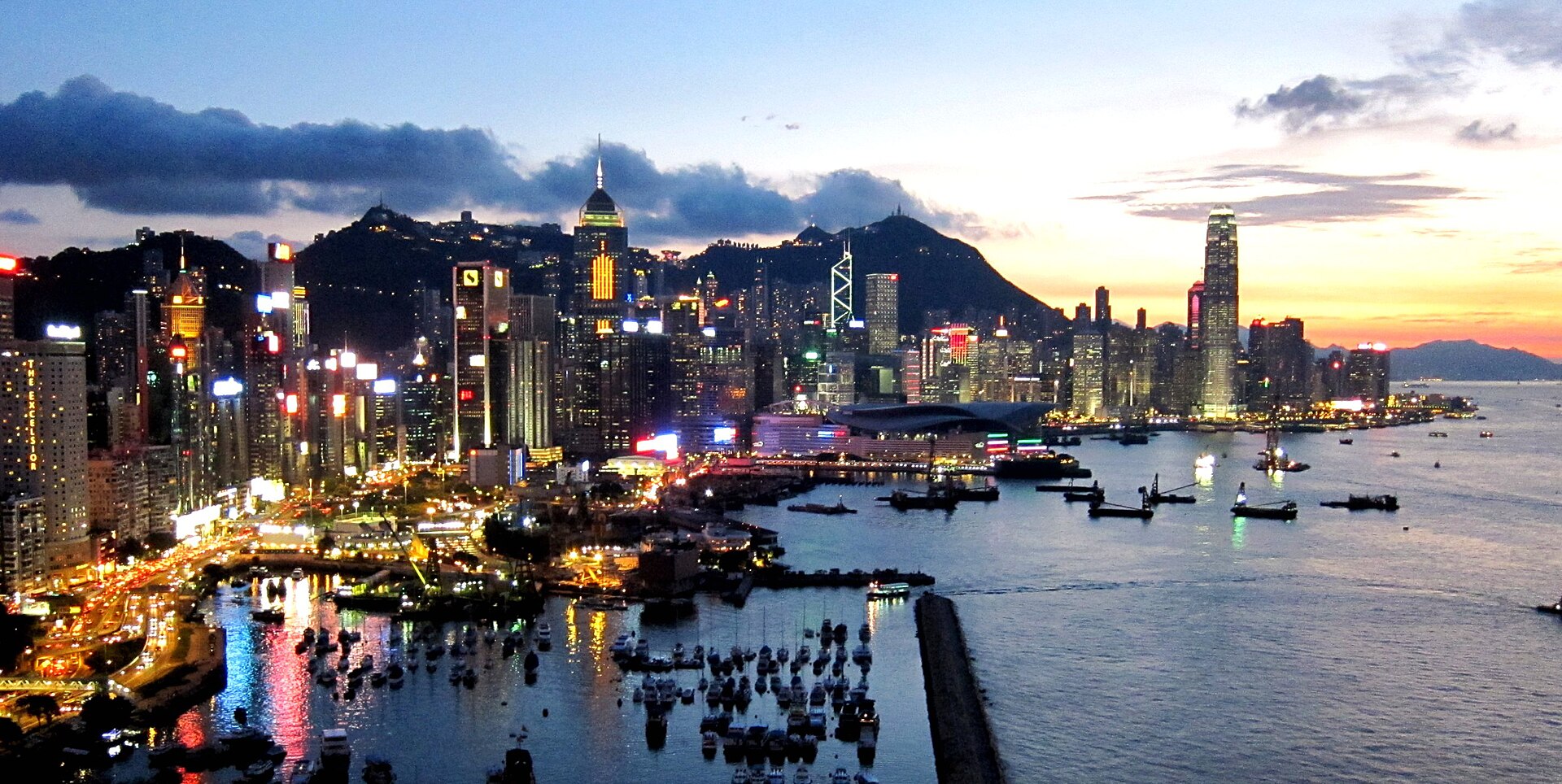
One of the world's deepest capital markets and a historic gateway between China and global investors. Property has been the defining asset of Hong Kong wealth for generations, and the territory has become one of Asia's two leading family-office hubs alongside Singapore.
0.2%stamp duty per stock trade, both sides
0%tax on capital gains and dividends
7.75–7.85HKD band against the US dollar
5% + 5%mandatory MPF, capped at HK$1,500 each
Capital
Hong Kong (special administrative region)
Currency
Hong Kong dollar
Main exchange
Hong Kong Stock Exchange (HKEX)
Regulator
Securities and Futures Commission (SFC)
How people invest in Hong Kong
Real estate dominates household and family balance sheets to a degree few other markets match. HKEX-listed China plays, family offices managing multi-generational conglomerate wealth, and gold round out the picture; tax incentives have drawn hundreds of new single-family offices since 2020.
Real estateHKEX equitiesFamily officesGold
Getting access
Residents and international investors face completely different mechanics here, so they are set out separately rather than blended into one set of instructions.
Living in Hong Kong
Opening an account as a resident
Hong Kong is one of the easiest markets in Asia for a resident to start investing in, and the reason is structural rather than technological: there is no capital gains tax, no dividend withholding tax, and no exchange control, so the account you open is simply an account.
Choose between a bank brokerage and a specialist broker. The retail banks bundle securities trading into the account you already hold, which is convenient and generally the more expensive option; standalone brokers compete hard on commission and platform quality.
Complete identity verification with your HKID. Remote onboarding is standard and no branch visit is normally required for a cash account.
Fund in Hong Kong dollars. Because the HKD is pegged to the US dollar in a 7.75–7.85 band, a Hong Kong resident buying US-listed assets carries far less currency risk than an investor funding from a floating Asian currency — one of the genuinely underrated advantages of investing from here.
Trade HKEX in HKD. Settlement is T+2. Stamp duty of 0.1% is charged to each side of every transaction, so a round trip costs 0.2% in duty before commission.
For mainland Chinese A-shares, use northbound Stock Connect through your Hong Kong broker rather than opening anything onshore. Northbound trades are not subject to Hong Kong stamp duty.
Your MPF is a separate system and is not optional. Since the eMPF Platform completed its rollout in January 2026 — HSBC SuperTrust Plus was the last scheme onboarded — every account sits behind one government-operated interface regardless of which trustee holds it, which finally makes consolidating old accounts from previous employers a realistic afternoon's work rather than a project.
International
Investing in Hong Kong from outside
Hong Kong imposes no foreign ownership limits on listed equities, no capital controls, and no withholding tax on dividends paid to non-residents. For a market of its size this is unusually open, and it is the reason most global investors reach it directly rather than through a wrapper.
Most international brokers offer HKEX access directly. There is no local trading code, no dedicated capital account, and no custodian requirement of the kind Vietnam, China or India impose.
Decide whether you actually want Hong Kong or China. A large share of HKEX market capitalisation is mainland-incorporated companies listed offshore, so a "Hong Kong" allocation is frequently a China allocation wearing a different jurisdiction's legal wrapper. That distinction matters for what you are exposed to.
Watch the counter. Eligible dual-counter stocks trade in both HKD and RMB; legislation now provides for stamp duty on RMB-counter transactions to be calculated and paid in renminbi, with eventual inclusion of RMB counters in Southbound Stock Connect the longer-term objective.
For fund exposure, Hong Kong is one of Asia's two large fund-domicile centres, and locally domiciled products sit alongside a deep menu of US- and Ireland-domiciled ETFs that hold the same underlying market.
The absence of a dividend withholding tax is a real and often overlooked advantage: on a US-listed China ETF a non-US investor typically loses 30% of dividends to US withholding, while a direct Hong Kong holding loses nothing at source. Your own country of residence will still tax you.
What you can actually buy
What is worth owning here depends heavily on which of the two audiences you belong to, because the tax treatment that makes Hong Kong attractive applies to residents automatically and to foreigners only at source.
Hong Kong and mainland equities
Both
HKEX is the access point for both the domestic market and, through northbound Stock Connect, the mainland A-share market. Southbound Stock Connect runs the other way, letting mainland investors buy Hong Kong-listed shares — and southbound flow has become a significant marginal buyer of this market rather than a curiosity.
The local mechanic: Stamp duty is charged on both the buy and the sell, at 0.1% each. It is small per trade and material to anyone who trades often — this is a market that quietly penalises turnover.
MPF and voluntary contributions
Residents
The Mandatory Provident Fund takes 5% from the employee and 5% from the employer, each capped by a HK$30,000 monthly relevant-income ceiling, so the maximum mandatory contribution is HK$1,500 a month from each side. It is the largest investment most Hong Kong workers will ever make and the one they think about least.
The local mechanic: Tax-Deductible Voluntary Contributions allow up to HK$60,000 a year to be deducted from salaries tax, but the money is locked until 65. That lock is the trade — worth taking if you were going to invest the money for the long term anyway, and a poor deal if you might need it.
Residential property
Both
Property is the dominant store of household wealth in Hong Kong and the asset most households are most leveraged into. Ad valorem stamp duty for a Hong Kong permanent resident buying a first home runs on Scale 2: 1.5% up to HK$3m, 2.25% to HK$6m, 3% to HK$10m, 3.75% to HK$20m and 4.25% above that, with a flat HK$100 charge on properties at or below HK$4m.
The local mechanic: The 2026 Budget introduced a flat 6.5% rate on residential transactions of HK$100m or more — a deliberate change at the very top of the market rather than a broad tightening.
Virtual assets
Both
Hong Kong runs a dual regime: the SFC licenses virtual asset trading platforms, while the HKMA licenses stablecoin issuers under the Stablecoins Ordinance, which commenced on 1 August 2025. The first two stablecoin issuer licences were granted on 10 April 2026.
The local mechanic: The protection is licence-specific, not blanket. Trading on an unlicensed offshore venue puts you outside the framework entirely — the regime is designed to make the licensed perimeter meaningful, which only helps if you stay inside it.
The fund and ETF route
Hong Kong is a fund distribution centre as much as a stock market, which means the practical question for most investors is not which local product to buy but whether to hold the exposure here at all.
Vehicle
Type
For
Notes
Locally domiciled funds and ETFs
Open-ended and listed
Residents and international
Distributed through bank platforms and brokers. For a Hong Kong resident these avoid the foreign withholding tax that applies to US-domiciled equivalents.
US-domiciled China and Hong Kong ETFs
Listed ETF
International
Deep and liquid, and the default for most non-Asian investors — but a non-US holder typically suffers 30% US withholding on the dividends, which a direct Hong Kong holding does not.
Ireland-domiciled UCITS
Listed ETF
International
The usual answer for European and many Asian investors precisely because the treaty position on US withholding is better than holding a US-domiciled fund directly.
MPF fund menu
Occupational pension
Residents
Constrained by scheme rather than chosen freely. Since the eMPF rollout completed in January 2026, comparing and consolidating across trustees is finally a single-interface exercise.
Hong Kong's private-market role is regional rather than domestic — it is where capital for the rest of Asia is raised and structured more than where it is deployed.
It is one of Asia's two dominant fund-formation and private-banking centres, alongside Singapore, and the competition between them has driven real concessions on both sides.
A listing regime for special purpose acquisition companies was introduced in 2022, adding a route to market that had not existed before.
For an individual, private-market access here runs through private banking relationships and licensed intermediaries rather than through anything retail — the minimums are institutional and the diligence burden sits with you.
Hong Kong's tax system is the single strongest argument for investing from here, and it is simpler than most summaries make it sound.
What
Rate
Applies to
Capital gains tax
None
No tax on investment gains for individuals
Dividend tax
None
No withholding on dividends, including to non-residents
Stamp duty on shares
0.1% each side
Buyer and seller, so 0.2% per round trip
Salaries tax (progressive)
2%–17%
On income after allowances and deductions
Salaries tax (standard rate)
15% / 16%
15% on the first HK$5m of net assessable income, 16% above
Basic personal allowance
HK$132,000
Per individual
MPF tax-deductible voluntary contributions
Up to HK$60,000
Deductible per year; locked until 65
You pay the lower of the progressive calculation and the standard-rate calculation, which is why high earners converge on the standard rate. Hong Kong taxes on a territorial basis, so the source of income matters more here than in most systems. This is general information rather than tax advice — your country of residence may tax gains that Hong Kong does not, and that is where most of the real complexity for internationally mobile people actually sits.
Risks worth pricing in
International
What international investors should weigh
Hong Kong is the most frictionless major market in Asia to buy. The risks are almost entirely about what you are actually buying rather than how you buy it:
You are probably buying China. A large share of HKEX capitalisation is mainland-incorporated companies listed offshore. An investor who allocates to "Hong Kong" for diversification away from China frequently has not diversified at all — they have changed the listing venue and legal wrapper while keeping the underlying economic exposure. Check what the index actually holds before treating it as a separate bet.
The peg exports someone else's monetary policy. Under the Linked Exchange Rate System the HKD trades in a 7.75–7.85 band against the US dollar, which means Hong Kong does not set its own interest rates in any meaningful sense — it imports the Federal Reserve's. A US tightening cycle transmits into Hong Kong mortgage and funding costs regardless of local economic conditions, and property is the channel through which that is felt.
Southbound flow has changed who sets the price. Mainland investors buying through Southbound Stock Connect have become a large marginal buyer of Hong Kong-listed shares. That is genuine demand, and it also means sentiment in the mainland increasingly sets the clearing price of a market that international investors think of as offshore.
Turnover is taxed. At 0.1% per side, stamp duty is trivial for a long-term holder and a real drag on anything resembling active trading. It is a market that structurally rewards patience, and the cost of ignoring that compounds quietly.
Residents
What domestic investors should weigh
For residents the tax advantages are real and permanent. The risks are concentration risks — and they are unusually severe here:
Property is most households' entire portfolio. Home ownership in Hong Kong typically absorbs the deposit, the leverage capacity and the monthly surplus of a household simultaneously. When your job, your home and your currency peg all key off the same economy, an equity allocation in the same market is not diversification. This is the strongest argument for a Hong Kong resident to hold assets outside Hong Kong.
The peg cuts both ways for you too. The stability that makes US-dollar assets low-risk for a Hong Kong earner also means local rates move with the Fed rather than with local conditions. A mortgage taken at the bottom of a US cycle reprices on a schedule nobody in Hong Kong controls.
MPF is a large investment made by default. Contributions are compulsory and the fund menu is set by your employer's scheme, so most people never make an active choice at all. Over a career the difference between a default fund and a considered one is substantial, and the eMPF Platform has removed the main practical excuse for not looking.
Licensed and unlicensed crypto are different products. The SFC licenses trading platforms and the HKMA licenses stablecoin issuers, with a HK$25m minimum paid-up capital and full reserve backing required of issuers. Those protections apply inside the licensed perimeter only. An offshore venue offering better pricing is offering it partly because it carries none of those costs.
How the market got here
Hong Kong has the longest continuous market history in the region, but almost everything that governs an investor today was written in the last decade.
1891The Association of Stockbrokers in Hong Kong is founded, the origin of organised trading here.
1986Four competing exchanges merge into the Stock Exchange of Hong Kong.
2000HKEX is formed and lists on its own market.
Nov 2014Shanghai-Hong Kong Stock Connect launches, opening mainland A-shares to international investors through Hong Kong.
Dec 2016Shenzhen-Hong Kong Stock Connect extends the same mechanism.
Jul 2017Bond Connect opens the mainland interbank bond market through Hong Kong.
2022A listing regime for special purpose acquisition companies is introduced.
Jun 2023The SFC's licensing regime for virtual asset trading platforms takes effect.
Feb 2024The government removes the residential property cooling measures introduced during the previous decade.
Aug 2025The Stablecoins Ordinance commences on 1 August, creating an HKMA licensing regime for stablecoin issuers.
Jan 2026The eMPF Platform completes its rollout, with HSBC SuperTrust Plus the final scheme onboarded.
Apr 2026The HKMA grants the first two stablecoin issuer licences on 10 April.
May 2026The SFC issues its circular on stablecoin services by licensed platforms, setting out client assessment and deposit arrangements.
Trends shaping Hong Kong
Regional investing patterns that show up strongly in Hong Kong — read the full analysis in investing trends.
No. Hong Kong levies no capital gains tax on individuals and no withholding tax on dividends, including dividends paid to non-residents. You do pay stamp duty of 0.1% on each side of a share transaction, so 0.2% per round trip. Your own country of tax residence may still tax gains that Hong Kong does not — for internationally mobile people that is usually where the real complexity is.
Can a foreigner buy Hong Kong stocks?
Yes, with unusually little friction. There are no foreign ownership limits on listed equities, no capital controls, no local trading code and no mandatory local custodian. Most international brokers offer HKEX access directly, which is a sharp contrast with Vietnam, mainland China or India.
Is buying Hong Kong shares the same as buying China?
Often, yes — and this is the single most useful thing to understand about the market. A large share of HKEX capitalisation is mainland-incorporated companies listed offshore, so a Hong Kong allocation is frequently a China allocation in a different legal wrapper. If you are buying Hong Kong to diversify away from China, check the index constituents first.
What is Stock Connect and do I need it?
It is the cross-border channel linking Hong Kong to the Shanghai and Shenzhen exchanges. Northbound lets investors buy mainland A-shares through a Hong Kong broker without any onshore account, and northbound trades are exempt from Hong Kong stamp duty. Southbound runs the other way, letting mainland investors buy Hong Kong-listed shares — and that flow has become a significant marginal buyer of this market.
How does MPF work and how much goes in?
Employer and employee each contribute 5% of relevant income, subject to a HK$30,000 monthly income cap, so the maximum mandatory contribution is HK$1,500 a month from each side. Tax-Deductible Voluntary Contributions let you add up to HK$60,000 a year against salaries tax, but that money is locked until 65. Since the eMPF Platform completed rollout in January 2026, all accounts are managed through one interface.
What stamp duty do I pay buying a home?
For a Hong Kong permanent resident buying a first property, ad valorem duty runs on Scale 2 — 1.5% up to HK$3m, 2.25% to HK$6m, 3% to HK$10m, 3.75% to HK$20m and 4.25% above — with a flat HK$100 charge on properties at or below HK$4m. The 2026 Budget added a flat 6.5% rate on residential transactions of HK$100m or more. Confirm your own position before committing; these rates are revised in budgets.
Is crypto legal in Hong Kong?
Within a licensed perimeter, yes. The SFC has licensed virtual asset trading platforms since June 2023, and the Stablecoins Ordinance, in force since 1 August 2025, created an HKMA licensing regime for stablecoin issuers requiring HK$25m of paid-up capital and full reserve backing. The first two issuer licences were granted in April 2026. Those protections do not extend to unlicensed or offshore venues.
Why does the currency peg matter to me as an investor?
Because it removes one risk and imports another. The HKD trades in a 7.75–7.85 band against the US dollar, so a Hong Kong earner buying US-dollar assets carries far less currency risk than an investor funding from a floating Asian currency. The cost is that Hong Kong cannot set its own interest rates in any meaningful way — it follows the Federal Reserve, whatever local conditions are doing, and mortgages are where households feel it.
Rates, thresholds and regulatory references on this page were last verified on . Hong Kong's rules are moving quickly — confirm anything you intend to act on against a primary source or a qualified adviser. Nothing here is investment, legal or tax advice.