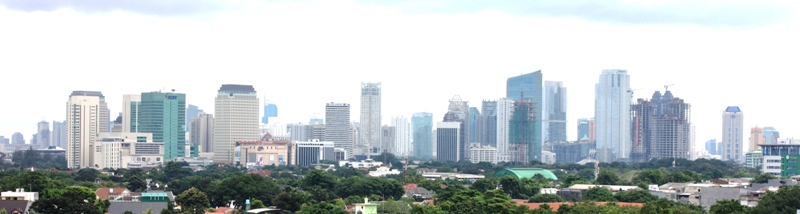
Southeast Asia's largest economy and most populous market has seen retail brokerage accounts multiply many times over in the past decade, driven by a young, mobile-first investing population.
0.1%final tax on gross share sale proceeds
Withheldautomatically by your broker
Profit or lossthe tax applies either way
SIDsingle investor ID required to trade
Capital
Jakarta
Currency
Indonesian rupiah
Main exchange
Indonesia Stock Exchange (IDX)
Regulator
Otoritas Jasa Keuangan (OJK)
How people invest in Indonesia
Sharia-compliant funds have a large, dedicated following given the size of the Muslim population; gold, property, and diversified conglomerate shares (several controlled by long-running family groups) round out household and institutional portfolios.
IDX equitiesSharia-compliant fundsGoldReal estate
Getting access
Residents and international investors face completely different mechanics here, so they are set out separately rather than blended into one set of instructions.
Living in Indonesia
Opening an account as a resident
Indonesia has one of the fastest-growing retail investor bases in Asia, built on very low minimums and app-based onboarding. The tax treatment is unusually simple and unusually blunt.
Open an account with an IDX member broker. You receive a Single Investor ID from the central depository, KSEI, which is the identifier tying together every account you hold.
Complete KYC and link a bank account. Minimum opening amounts are deliberately small — this market was built to be accessible.
Trade IDX in rupiah. Settlement runs T+2.
Understand the tax before you trade, because it is not what most investors expect: every sale of listed shares attracts a final withholding tax of 0.1% of gross proceeds. It is deducted by your broker automatically, and it applies whether the trade made money or lost it.
Because the charge is final and transaction-based, there is no capital gains calculation to make and nothing to file for ordinary share trading. Simplicity is the trade-off for paying on losses.
Sharia-compliant investing is a significant and well-developed segment here rather than a niche, with screened indices and dedicated products — reasonable in the country with the world's largest Muslim population.
International
Investing in Indonesia from outside
Indonesia is open to foreign portfolio investment, and the practical constraint is currency and liquidity rather than permission.
Foreign investors can hold Indonesian listed equities, obtaining a Single Investor ID through a local custodian or broker.
The same 0.1% final tax on gross sale proceeds applies to foreign sellers.
For most individuals an Indonesia ETF is the practical route, and avoids the custody arrangements entirely.
Model the currency seriously. The rupiah has a long history of depreciation against the dollar punctuated by sharp devaluations, and it is the dominant variable in long-run foreign returns from this market.
Indonesia is a commodity-linked economy with a large domestic consumer base. Which of those two you think you are buying should drive whether you want broad index exposure or something more targeted.
What you can actually buy
Indonesia's market is young, retail-heavy and concentrated in banks, commodities and consumer names.
IDX-listed equities
Both
Dominated by banks, resources and consumer companies. Liquidity is good at the top and thins quickly below the large caps.
The local mechanic: The 0.1% final tax on gross proceeds means turnover is directly and unavoidably costly — and that losing trades are taxed too.
Government bonds and retail sukuk
Residents
Indonesia issues retail government bonds and sukuk in small denominations specifically aimed at individual savers, and they are genuinely popular.
The local mechanic: These are among the more accessible sovereign instruments anywhere in Asia for small investors, with minimums set deliberately low.
Sharia-compliant products
Both
Screened indices, sharia mutual funds and sukuk form a substantial and well-established part of the market rather than a specialist corner.
The local mechanic: Screening excludes conventional financials, which in a bank-heavy index is a very large structural tilt rather than a minor filter.
Property
Both
A major domestic asset class. Foreign ownership is restricted and structured around use rights rather than freehold title.
The local mechanic: Foreigners cannot hold freehold land. Arrangements that appear to grant it — including nominee structures — carry real legal risk and have cost foreign buyers their money.
The fund and ETF route
The domestic fund industry is growing quickly from a small base, and offshore products are the simpler route for foreigners.
Vehicle
Type
For
Notes
Domestic mutual funds
Open-ended
Residents
Regulated by OJK, distributed through banks and app-based platforms with very low minimums.
IDX-listed ETFs
Listed ETF
Both
A smaller market than the region's largest, with liquidity to check before sizing a position.
Retail government bonds and sukuk
Sovereign
Residents
Issued in small denominations aimed specifically at individual savers.
Offshore Indonesia ETFs
Listed ETF
International
The practical route for foreign individuals, with no custody or investor-ID requirement.
Indonesia has Southeast Asia's largest domestic market, and its startup ecosystem has been shaped by that scale.
The country produced several of the region's largest technology companies, and their subsequent public-market performance has significantly recalibrated local venture expectations.
Domestic corporate and conglomerate capital is an important funding source alongside regional venture firms.
For individuals, access is largely through funds and syndicates rather than direct investment, and the exit path remains the binding constraint.
Indonesia's treatment of listed share sales is one of the simplest in Asia, and the simplicity cuts both ways.
What
Rate
Applies to
Sale of listed shares
0.1% final
On gross proceeds, withheld by the broker
Applies to losing trades
Yes
The charge is on proceeds, not gain
Capital gains calculation
None required
The final withholding replaces it for ordinary trading
Founder shares sold around an IPO attract an additional charge, and rules for unlisted shares, bonds and funds differ from the listed-share treatment described here. Non-residents should check their treaty position. This is general information rather than tax advice.
Risks worth pricing in
International
What international investors should weigh
Indonesia's demographic and resource story is genuinely strong, and it has historically been undone by two things:
Currency has repeatedly erased equity gains. The rupiah has a long depreciation history with episodic sharp moves. A good decade in local currency terms can be an unremarkable one in dollars, and this is the single most important thing to model.
Commodity linkage runs deeper than the index suggests. Resource prices transmit into the currency, the trade balance and government revenue simultaneously. Exposure to Indonesia is more correlated with commodities than a look at the sector weights implies.
Liquidity thins fast below the large caps. Position sizing that works in a deep market will trap you here. Exiting a mid-cap position in a falling market is materially harder than entering it.
Policy can change quickly. Export restrictions on raw commodities have been used decisively as industrial policy. That has been good for some domestic industries and abrupt for investors positioned the other way.
Residents
What domestic investors should weigh
A young investor base meeting an accessible market produces a predictable set of problems:
The 0.1% tax makes trading expensive in a hidden way. It looks trivial per transaction and it is charged on every sale regardless of outcome. Active traders pay it on their losses as well as their gains, which is not how most people mentally account for tax.
Investment fraud has been a recurring problem. Unlicensed schemes promising fixed high returns have repeatedly attracted large retail losses. Checking OJK registration before committing money is the single highest-value habit available here.
Concentration in banks and commodities. The domestic index is not diversified in the way its size implies. A local portfolio plus a local salary plus local property is one economic bet made three times.
Nominee land structures do not work. Arrangements marketed to foreigners as a way around freehold restrictions have failed in court. Residents advising foreign partners should treat this as settled rather than grey.
How the market got here
Indonesia rebuilt its capital market after the Asian financial crisis and has spent the last decade widening retail access.
1912A stock exchange operates in Batavia under Dutch colonial administration.
1977The Jakarta Stock Exchange is reactivated after independence-era closure.
1997The Asian financial crisis devastates the rupiah and the banking system.
2007The Jakarta and Surabaya exchanges merge to form the Indonesia Stock Exchange.
2011OJK is established as the integrated financial services regulator.
2018Minimum trading lot sizes and account minimums are cut sharply, opening the market to small investors.
2021Indonesia's largest technology companies list domestically, and the retail investor base expands rapidly.
Trends shaping Indonesia
Regional investing patterns that show up strongly in Indonesia — read the full analysis in investing trends.
Every sale of IDX-listed shares attracts a final withholding tax of 0.1% of gross proceeds, deducted automatically by your broker. Because it is charged on proceeds rather than profit, it applies to losing trades too. In exchange there is no capital gains calculation to make and nothing to file for ordinary share trading.
What is a Single Investor ID?
A unique identifier issued by the central depository, KSEI, that ties together every securities account you hold. You need one to trade, and it is obtained through your broker as part of account opening.
Can foreigners invest in Indonesia?
Yes. Foreign investors can hold Indonesian listed equities via a Single Investor ID obtained through a local custodian or broker, and the same 0.1% final tax applies on sale. For most individuals an offshore Indonesia ETF is simpler and requires none of that.
Can foreigners buy property in Indonesia?
Not freehold land. Foreign ownership is structured around use rights rather than title, and the nominee arrangements sometimes marketed as a workaround have failed in court and cost buyers their money. Treat any structure that appears to grant a foreigner freehold as a warning sign.
Is sharia-compliant investing widely available?
Yes, and it is mainstream rather than niche — screened indices, sharia mutual funds and sukuk are all well established. One structural consequence worth knowing: screening excludes conventional financials, and in an index heavy with banks that is a very large tilt rather than a minor filter.
Rates, thresholds and regulatory references on this page were last verified on . Indonesia's rules are moving quickly — confirm anything you intend to act on against a primary source or a qualified adviser. Nothing here is investment, legal or tax advice.